Friday, May 13, 2016

The Young Nurse


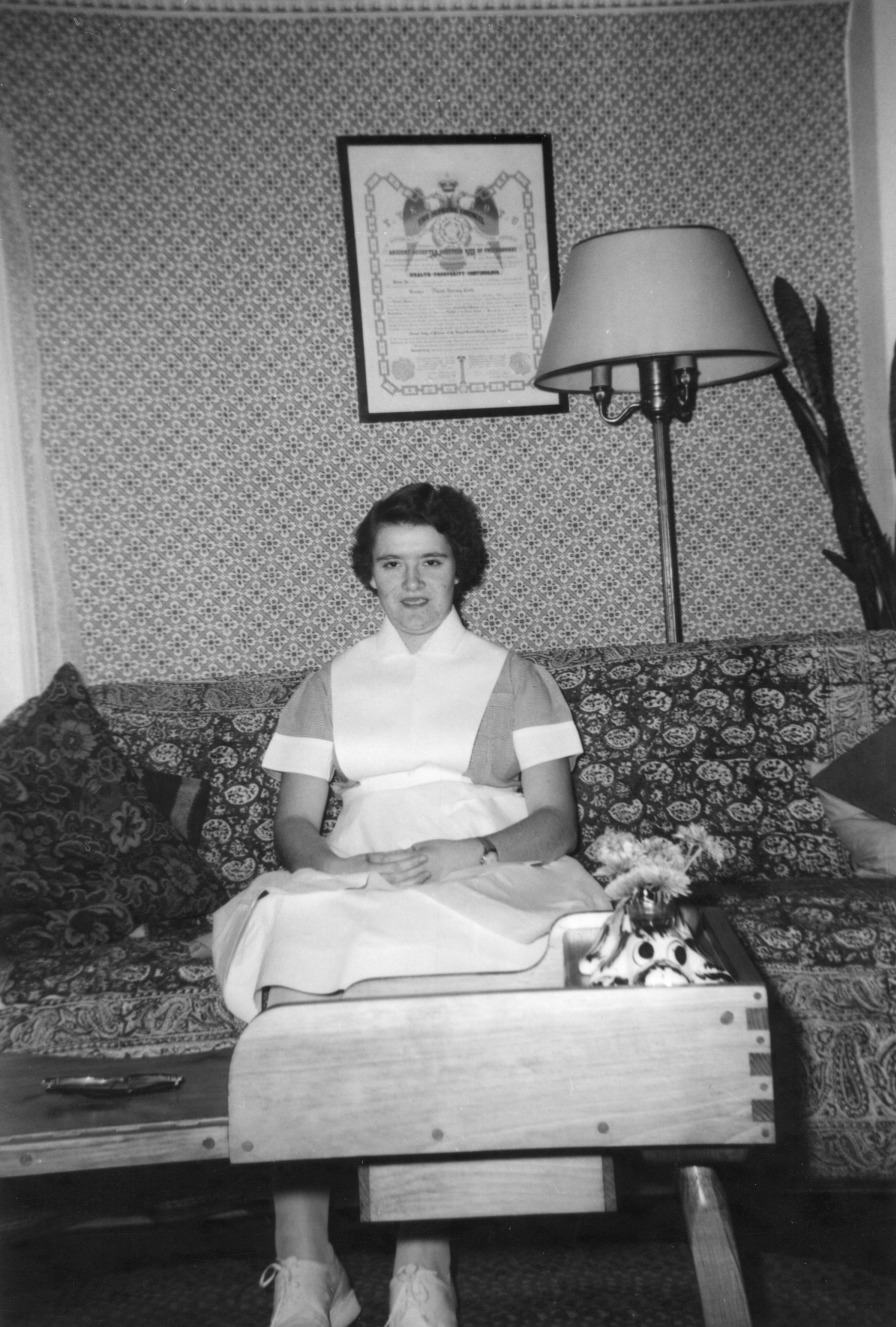
Or maybe she's a candy striper.   I have no idea. In any case, there's some sort of document on the wall with the Russian Double Eagle, symbol of the Czars.

Thursday, May 12, 2016

Cleo and Friends


Written on the back, "Cleo, Marion, Betty, Judy  Oct. 21,1945."  Yesterday's post dated from January 1942, just a month or so after America's entry into World War 2.  Today's post just a few months after the war's end.   Whenever I see pictures of civilians from the war era, I'm always reminded that they almost certainly knew someone who was killed or wounded.  It's not like that anymore.  We've been involved, militarily on some level, in Iraq and Afghanistan for more than a decade, and I don't know a single person who has been killed or wounded in those conflicts, nor do I know any person who has family that has died.   We could have small numbers of troops, in combat, for another twenty years, and it would still be possible to never know any actual casualties or their families.  I guess that's why it's so easy to tolerate our involvement.

Wednesday, May 11, 2016

Baby It's Cold Inside


  As I've noted in other posts, I sometimes buy envelopes of photos.  If the price is low enough, I'm willing to purchase an envelope for one or two prints.  As the price goes up, I have to want at least half of the images.  As such, I do end up with a lot of snapshots that aren't necessarily bad, but are far less interesting than I'd like.  In a nut shell, I've got a lot of photos, sitting on my desk, that have been there awhile, and it's time to publish some of them.  For the next few posts I'm going to concentrate on the largest single category, women in singles and groups.

This one's dated, "Jan 22, 1942" and it reminds me of home.  No, I didn't grow up in a house with three girls, but I did grow up in a house that was cold during the winter.  When I was born, in 1955, our home was heated by coal, but by the time I was four, we had transitioned to natural gas.  A year latter, my parents split up, the household was a lot poorer, and in order to save money, my mother turned down the winter heat to 50 degrees.  Anything lower than that, and the pipes in the basement would burst.  To keep warm, I'd sit on the floor register, and let the warmish air blow over me.

In 1942, the war had started, and rationing had become the new normal.  Coal was a strategic material, and since most homes were heated by coal, winter became a chilly time for Americans.  Since this photo has the classic steam register, I suspect it was taken in a big city apartment.  The poor super would have to get up in the middle of the night to shovel more coal into the boiler, while his chilled tenants would huddle near the register to stay warm.  Oh for the end of the war so the "sup" could shovel on the cold and make things nice and toasty.

Monday, May 9, 2016

Bob Welker In the Desert


It looks like Bob is moving, and there's a good chance that it wasn't voluntary.  You might have to click on the image to bring it up in a bigger window, but the hood's up and there's a tire pump in the back seat.  How many more miles to the big city?

Saturday, May 7, 2016

Tired Feet, A Convenient Seat


You take a walk, you're feet get tired,  you need a rest, you use the seat that's available.

Thursday, May 5, 2016

The Civilian Army


This one has a processors stamp on the back dating this print from the "Week of August 29, 1955", putting it somewhere in between Korea and Vietnam.  Since it's almost impossible to put a date on the beginning of the Vietnam War-did it start before U.S. involvement, the arrival of trainers, the first troops in the field, the Gulf of Tonkin incident-we'll just say a lot closer to Korea.

So, here's a fun fact about the U.S. Army in the 1950's.  After the end of World War 2, it was assumed by many Americans that the draft would come to an end, and everyone could go on with their lives with no fear of being called up.  But that wasn't to be.  Fear of Soviet aggression, the perceived need to keep an occupying force in Europe and Japan, kept the military in need of fresh troops, so the draft continued apace.  Never popular, it didn't take long for the whole issue of deferments to come up.  In 1950, with the backing of many in the academic community, the army decided that college students, based on their grade point average, could avoid conscription.  Needless to say, the A students could stay at home, while those with a sold C risked  a quick trip to basic training.

One of the few academics to argue against a deferment system of any kind was Harvard President James B. Conant.  He thought universal service for all 18 year olds was preferable.  In his writings he made a whole host of points, but what it all got down to was that if we were to have a military and if it was necessary to defend the country, than it was undemocratic that that burden should fall on some, and not on everyone.  Conant lost the argument.  By the time Vietnam came along, there were so many deferments that we had effectively divided the country into two categories: those who were worth saving and those who were disposable.

I was from a small coal mining town in western Pennsylvania, and I was in the disposable pool of Americans.  I got lucky. January 23, 1973, my 18th birthday, the Paris Peace Accords were signed, ending American involvement in Vietnam.  (There were no Americans in combat when Saigon fell in 1975.) The draft ended not long after that, and my assumption that I'd get swept up and sent to southeast Asia was proved wrong.

This is the last of the photographs from the military memorabilia envelope.  Sort of.  I do have a couple of press clippings, one with a picture, but if I decide to post it, it will be on my Fair Use blog.  I've already published a couple of documents from this collection, but I haven't felt the obligation to put them all on line.  Maybe they'll show up some day, maybe not.
Tuesday, May 3, 2016

At Attention


This one's an 8x10, and I suspect it's an official photograph for release to the press.  I had hoped that I'd be able to get an ID from the patch on the sleeve, but that was a no go.