Showing posts with label Albumen print. Show all posts

Tuesday, December 13, 2016

Gilbert & Bacon


Not Gilbert & George!

William Frank Bacon was born in 1843 in Bangor, Maine.  After serving in the Union Army during the Civil war, he settled in Philadelphia with the intention of becoming a photographer.  He apprenticed under  A.K. P. Trask, and after a brief stay in New York City was invited by Trask to become his partner at a studio at 40 N. Eighth St., Philadelphia.  In 1870, Trask was bought out by C. M. Gilbert.  Gilbert & Bacon opened up a new studio at North 820 Arch St.  Bacon was the dominant photographer of the two.  While Gilbert handled much of the walk in clientele, Bacon handled the higher end work.  In a world before movies, cities like Philadelphia had a stage community rivaling that of New York City, and Bacon became the photographer of choice for  famous performers, as well as athletes, authors, and politicians.  Then, it was common practice for photographers to photograph the famous for free and then make their money by selling those portraits to the general public.  In 1886, Gilbert retired and Bacon operated the studio by himself while keeping the Gilbert & Bacon studio name.  Bacon opened up a new studio at 1030 Chestnut St., leaving the management of the Arch Street location to Milton R. Hemperly, who had been hired by the partners in 1883.  (Hemperly bought the Arch street location, from Bacon, in the mid 1890s, and operated it under his own name.) William Frank Bacon died in 1900 of Bright's Disease, and the ownership of Bacon & Gilbert fell to his son Frank T. Bacon.  Frank kept the business running until 1925.  In 2011, 10 original proofs, photographs printed from the original negatives at the time they were exposed, sold at auction for $16,000.  Of course, those prints were of the famous and were almost surely taken by William Frank Bacon, while this cabinet card was probably shot by either Gilbert or Hemperly.



Tuesday, December 2, 2014

One Big Happy Family


I don't know about other collectors of old photos, but I always have doubts about what I'm told by the people who sell them.  When I get a lot like this, I ask if all the photos are from the same source.   The dealers, of course, can intuit that I'm interested in buying images from the same family, so they tell me that, of course, all the same big family.  I know that sometimes they're telling me the truth.  I also know that sometimes they're just telling me what they know I want to hear.  I think I see a family resemblance, and at least one man who's in two photos, but that could be wishful thinking.

Thursday, March 20, 2014

Elizabeth From Louisville


Elizabeth Ratherin Phillips, at least that's what's written on the back of the card.  This photo is mounted on a card with a very faint, as in not readable when scanned, studio mark...."HEATH'S STUDIO 1411 W. MARKET ST. LOUISVILLE, KY"  I wasn't able to find much about Heath's Studio.  Just that Heath was Bruce C. Heath and he was in business at the Market Street address from 1896-1907.  Before that and after, haven't a clue.

Monday, July 1, 2013

Yet Another Cabinet Card


Unlike yesterday's post, this one has a studio mark on the border, so I didn't crop to the image.  I wasn't able to find much about Henrici's Studio.  Herman Henrici was in the Philadelphia city directory as a photographer as early as 1865.  He was also listed in 1867 and 1868.   For those interested, the information comes from langdonroad.com a list of nineteenth and early twentieth century studio photographers.  I haven't scrolled through the site, so I don't know how comprehensive it is.

Sunday, June 30, 2013

Just Another Cabinet Card


I've had this one for awhile, and it's time to put it up.  There's no studio mark on the borders or on the back, so I haven't a clue where it's from.

Wednesday, March 13, 2013

Told Ya So


There is something wonderfully theatrical about this one.  Of  course, Fort Dodge, Iowa isn't exactly a center of the theater arts. With the parasol off  to the side and the young lady wagging her finger at the camera, well it's just a great composition.  A rare find in a cabinet card.

Tuesday, March 12, 2013

Cabinet Cards, Little Boys In Dresses


Once again, we return to the strange nineteenth century custom of dressing little boys as girls for the first four or five years of their lives.  I've run across a number of explanations for this practice and the only one that ever made sense to me was that boys needed maternal attention before they became little men.  So mother's daughter to father's son.  Hey, it's something, even if it's not right.

Monday, March 11, 2013

More Cabinet Cards


These cabinet cards, at least to me, are far more interesting for what's on the back, rather than the photo itself.  It didn't happen often, but every once in awhile, when I worked at the photo lab, someone would bring in some old glass negatives and were surprised when I told them that I could blow them up, or reduce them down without having to make a same size contact print and then a modern copy negative.   It is nice to see on the J. R. Pearson card an offered service of prints made from locket size to life size.  Too, hand colored with ink, crayon or water color, for those who have wondered what kind of pigments were used for the many hand colored photos floating around out there.  As a matter of fact, a photo supply store I use, Freestyle Photographic Supplies in Los Angeles still offers oil pencils and water color for hand tinting.  Haven't tried it myself, but who knows what the future holds.

Sunday, March 10, 2013

Cabinet Cards From York, PA


I'll be putting up some cabinet cards over the next few days or so.  Some will hold interest only for those fascinated by nineteenth century portraits, and a couple will have other things going for them.  I wasn't able to find anything about the Kauffman photo studios of York, Pennsylvania, but I did find some other examples of his (Unlikely for the time period, but possibly her.) work.  None were out of the ordinary.  

Thursday, November 17, 2011

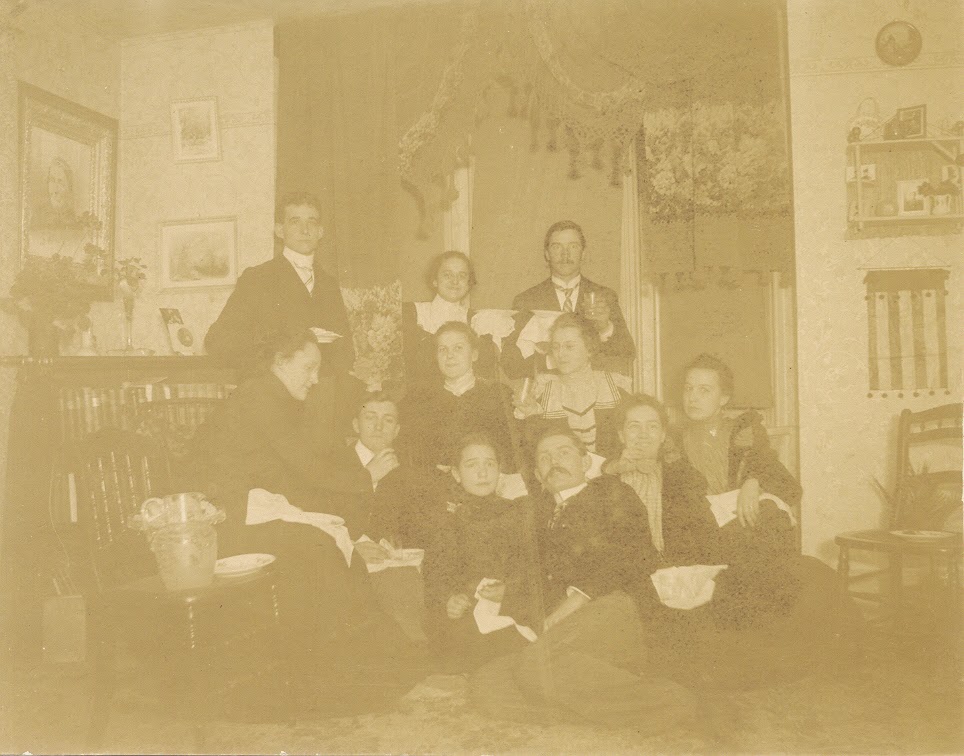
Before Taking


So what were they taking on Dec. 1st, 1905? I'm assuming that we are looking at five couples, (I've spotted one wedding ring.) who are about to go off on some sort of adventure. Perhaps a trip to a far off city or maybe even Europe. Perhaps they're missionaries headed off to the far east. Maybe it's a trip to one of the health resorts that were quite popular in that era. Maybe they are college students about to take winter finals. Maybe something very simple like a sleigh ride. So many choices, so few clues. Just the way I like it.

Friday, September 30, 2011

The German American Collection, The Broken Ones


It's my preferred practice, when scanning mounted prints, to crop out everything but the actual photograph. Too, I prefer not to impose a symbolic meaning to old, family photos. But in this case, where a dealer went to an estate sale and bought up boxes of old photos that no one was willing to save from the prying eyes of strangers, it only seems right that there should be some damage to things. Take a good look at the child on the left in the final print. I'm convinced that's a little boy in the dress. What were they playing? Peter Pan? Click on German American in the labels section to bring up the rest of the collection.

Friday, September 2, 2011

A Nineteenth Century Wedding


EBay can be an expensive way to collect old photos. Believe me, I've found that out the hard way. But, if you're willing to spend time scrolling through page after page of old photos, from time to time something interesting and affordable will come up. I hadn't really been looking for cabinet cards, but there they were. Nine, starting price of 99 cents, two bucks for shipping and not a single bid. Anyway, this was one of the ones I liked for a rather perverse reason. I'm a big believer that as photographic technique improved over the years, so did the subject's relationship to the camera. Stiff and formal was the standard, lively with a sense of movement a rarity. It took decades for the people being photographed to learn to relax and show some humanity. I'm fascinated that these people looked so stark on the big day. There is a studio mark embossed on the card, "D. A. Frommeyer -HANOVER, PA-" All I could dig up on Mr. Frommeyer is that he had a studio in Hanover from 1886 to 1911.

Monday, August 29, 2011

Carte de Visite/Ohio


Well, I haven't put up a carte de visite for awhile so I thought I'd put these two up. Other than that they are both from Ohio, they aren't related in anyway. The profile has a studio mark on the back, "Geo R. Elliott, S.W. Corner High and Town Streets. Columbus, Ohio" And written, "Julianne Elizabeth Anthony (Mother)" Elliott was born in 1837 and had a studio in Columbus from 1870-86. A photographer for hire, his specialty was stereoscopic views. In 1886 he became the employee of James Madison Elliott, presumably a relative, who in addition to being a photographer was also a painter and crayon artist. Neither man was a great talent, but they made a living at it. On the mother/daughter portrait (I'm guessing), written on the back, "Jennie E. & Bell M. Norris, Stryker, Ohio" Stryker is in the northwest corner of the state, near the Michigan border. Click on either cdv or carte de visite in the labels section to see a lot more. The carte de visite was an early attempt at a standardized photographic format. They were small albumen prints mounted on a card, approximately 2.5x4.25 inches. While some people did in fact use them as visiting cards, they were usually given as keepsakes to friends and family. In the 1860s and 70s, the term cartomania was used to describe the craze for collecting as many cartes de visite as possible. Kind of like friending as many people as possible on Facebook.

Wednesday, August 10, 2011

Betty in the Center


This one falls in the "I wish it were in better condition" category. Is the girl in the center the self assured child of the family, or the immigrant maid of a nice middle class household? With her hands on her hips, staring into the camera lens, she has an air of confidence that things are going to go her way in life. If it wasn't for the apron, I'd go with family member. Written on the back, "left on face, Mrs. Clark Grandma, right on face, Mrs. Welkman Aunt Hanna, Betty in center & Norman on steps." Mounted on cardboard. Written on the front bottom margin, "Mrs. Clark, Rita, Mrs. Welkman." So which is it, Betty or Rita?

Friday, July 29, 2011

Alfalfa, Sr. Cabinet Card


I dare anyone to tell me that this guy doesn't look like Alfalfa from The Little Rascals. All that's missing is the cow lick and a few freckles. This card was probably made in the nineteenth century, so it is possible that this man could be an ancestor of little Al. Nice tie, too.

Saturday, July 16, 2011

Mrs. Nancy A. Larkins


I wish this one was in better shape. The lady is beautiful. Written in pencil on the back, "Mrs. Nancy A. Larkins, Browns to right of market. 6x8 = Blk frame no 100, New Silver-oval or square which ever will show best. Dec. 19-250 No 136." Stamped in red ink, "DEC 1, 1904" Mounted on card, there is an embossed studio mark, but the name of the photographer has worn to the point of being unreadable. I can make out Blairsville, PA, though.

Sunday, June 5, 2011

Two Girls, One Boy


My best guess is that this picture was taken in the late nineteenth to early twentieth century and what a future these children would face. Let's assume that these three kids are children of an American middle class. All children of the poor and working classes were raised to eventually make a living, but for the middle class and the wealthy, girls were raised to make a marriage. They would have been given an education that would have given them a certain amount of charm, wit, and grace. Perhaps it would have included a women's college, perhaps not. Boys would have been raised to their father's business, a true career, and membership in an appropriate club. But things change. These three would have faced World War 1, a flu pandemic that may have killed as many as 100,000,000 people in eighteen months. Then the roaring twenties, probably the period of greatest social change in the last 100 years. Then the great depression, 30 % unemployment at a time when most women didn't work which probably would translate into 50 % unemployment by today's standards. Then World War 2, and if these three kids were born no earlier than the 1890s, there was a decent chance that, at the least, they lived to see Korea and the beginning of Vietnam. May you live in interesting times.

Friday, June 3, 2011

Marie and Malcolm Carskadden


An albumen print, mounted on a card, "Marie and Malcolm Carskadden" written on the back. I did a search on both Marie and Malcolm Carskadden and couldn't find a thing.

Wednesday, May 18, 2011

What Makes a Great Cabinet Card Part 2?


Yesterday I asked the question, with millions to choose from, what makes a great cabinet card. Well, here is an example. The photographer, M.J. Streuser from Bellevue, Iowa had a great eye for composition, the subject matter, a group of guys out having a good time, the sense of movement one gets from Arnie brandishing his club. Wow. I feed the name M.J. Streuser into Google, not expecting much, and found another example of his work on the Cowan Auctions site, of a photographer and his assistant posing with their wares. Probably a self portrait and it was wonderful too. I really recommend that others visit and take a look. The very first post I put up on this blog was a group of prints I made from a set of glass negs, all from the same photographer, and the thought of picking up more Streuser prints, well it's the same. Written on the back, "Arnie, Geo. Zentiner, Frank Kegles, Charles Hartley, Ed Kamp, Phil, Joe Brandt, From one of Arnie's birthdays." Go punch in M.J. Streuser into Google before the Cowan Auctions site takes down the cabinet card I mentioned, and please use the archives section to the right to navigate back to Montana Glass Negatives, pubished on June 9. 2009.

Friday, April 1, 2011

Cabinet Card-Two Children


Two little girls? Very likely, but not a sure thing. There was a custom among the upper classes of the nineteenth century of keeping little boys in dresses and long hair until they were three or four years old. Then it was knee pants, and not until a certain age, long trousers.