Showing posts with label world war 1. Show all posts

Sunday, December 14, 2025

Field Rations


 I don't know when or where this photo was taken, but if I were to guess, I would say World War 1.  The helmets don't look like the flat type worn by the U.S. or British armies.  I think, though I'm not sure, these are French troops.  

Monday, October 24, 2022

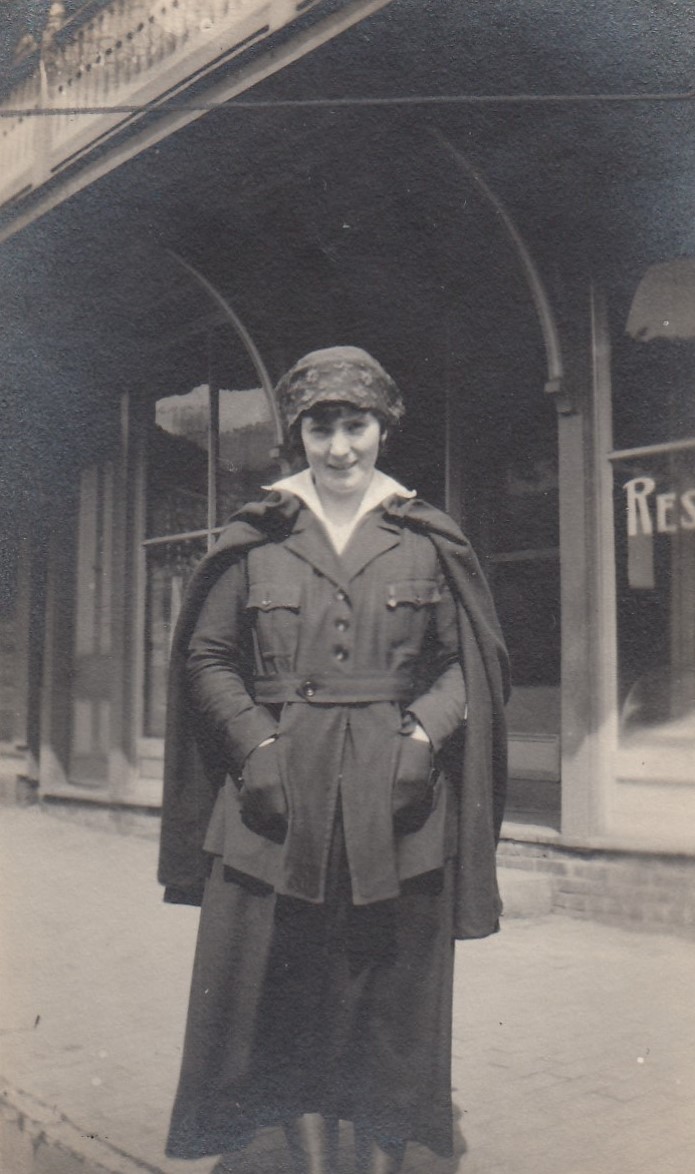
Women in Uniform


I'm fairly certain that this young woman is wearing a uniform of some kind.  I know I've seen it before, but where? A World War 1 era military nurse is my best guess, but I can't be sure.  Anyway, there's an American flag in the restaurant window, and the pencil line drawn on the top image may indicate a crop for newspaper reproduction. 

Friday, April 3, 2020

All Things Considered


We've got two young men in military uniforms and judging by the car in the background, this photo was probably taken some time during the World War 1 era.  Maybe before, maybe during.  Usually when I see images of young men going off to war I can't help but wonder if they survived.  But, considering what we're going through right now I can't help but wonder how many of the people in this picture survived the Spanish flu. 

Thursday, November 29, 2018

Soldiers and Civilians


I think those are American uniforms and I think they're from the World War 1 era.  If I were guessing, I'd say that the men in uniform are visiting college classmates.  No real reason to think that, it's just a gut feeling.

Thursday, September 7, 2017

Russland 4


I've saved my favorite for last.  Literally, the second photo in the column is my favorite.  That second photo is dated "16 VI 18," a date well within the revolution.  When the pictures in this series  were taken, it was still possible to get out.  It was also possible to get shot for being in the wrong party, or the wrong class.  Since these photos  made it to the United States, I'm guessing that most, if not all of the people in these pictures headed west and avoided the worst of the Stalinist terror.  Take a close look at the top picture.  The man on the right is holding a pair of binoculars.  Was he watching birds, or was he watching for Bolsheviks?

There is a movie, directed by Joseph Von Sternberg, that's supposedly based on a real person.  In The Last Command, Emil Jannigs played a Russian general who works as a movie extra in Hollywood.  I've never seen it, but as a silent movie fan, I hope to.

Anyway, click on Russland in labels to see the rest.

Wednesday, July 12, 2017

The Here, There, and Everywhere Collection-Two Men, One Cannon


Another from the occasionally posted Here, There, and Everywhere Collection, something to be clicked on in labels to see other images, and get the low down on the title.  So, two men sitting on what looks like World War 1 era cannon.

Friday, June 16, 2017

Port Said, The Queen Victoria Monument


There's no way in hell that I'm going to try and make out what's on the back of this card, so I'm breaking protocol and posting it.  Besides, I like the Arabic lettering. .

This is the last of my Egyptian postcards, at least until I find some more. This one was published by Lichtenstern & Harari.  Joseph Max Lichtenstern was an Austrian photographer who moved from Vienna to Cairo in 1893.  Starting in 1899, he began publishing postcards of his photographs as The Cairo Postcard Trust.  Two years latter, in 1901, he partnered with David Harari.  They expanded into general publishing and also import and export.  In 1912, the partnership dissolved after Harari decided to move on.  The company was sold to Max Rudman. Lichtenstern stayed on in Cairo.  He returned to Austria for a vacation in 1914, was trapped in the country by World War 1, and served in the Austro-Hungarian Army for the duration.

Just a quick, and vastly simplified, historical note.  In the mid nineteenth century, Egypt was part of the Ottoman Empire.  After the construction of the Suez Canal, the British more or less manufactured an incident (And this is the simplified part.  There are a a lot of very good books out there for people who wish to follow up.  And no, Wikipedia isn't a good source.)  that allowed them to seize Egypt and control the canal.  When the Ottomans tried to take it back in World War 1, the British allied themselves with the Arab revolt. Lawrence of Arabia, anyone?  After the war, they betrayed their Arab allies by making a secret deal with the French, The Sykes Picot Agreement,  that divided Arab lands from the Mediterranean to modern day Iraq between them.  So no, Virginia, it's less about religion and more about the legacy of imperialism.  The gift that keeps on giving.

Thursday, June 8, 2017

The Statue of Ramses


Yet another unused card, credited to "Lehnert & Landrock, Cairo"  I've actually been able to find some info on this pair.  Rudolf Franz Lehnart and Ernst Heinrich Landrock were a pair of Austrian born photographers who met each other in Switzerland in 1904.  The two formed a partnership in Tunis, where Landrock had taken a series of photographs, which lasted until 1914, when they were interred by the French as enemy aliens, at the beginning of World War 1.   Their large collection of glass plate negatives were also seized.

They didn't meet up again  until 1920.  With the dissolution of Austria-Hungary,  Landrock found himself a citizen of the new nation of Czechoslovakia, an ally of France, which allowed him to get the partner's negatives returned to him.  Lehnert had returned to Tunis where he photographed nudes for Jouret Studio.  They formed a new partnership, in Cairo,in 1924, where they published postcards from their photographs.  Lehnert sold out his half of the business to Landrock in 1930.  In 1939, fearing another internment, Landrock left for Germany.  He left the business under the management of his Swiss born nephew, Kurk Lambelit.  It's believed that the majority of the negatives from the partnership was destroyed by allied bombing, in Germany, during World War 2.

  Lehnert & Landrock is still in business, in Cairo, as a publisher of guide books.

Friday, October 21, 2016

Woodrow Wilson in Paris


This postcard was published by "E. Le Delay, Boulevard de Sebastopol, Paris."  Ernest Louis Desire Le Delay was a French photographer.  He was born in 1859, and specialized in French and North African landscapes.  In 1900, he founded a postcard publishing company that made both photographic and illustrated cards.  During World War 1, his company produced a large number of battle scene cards with captions in both French and English.  He died in 1917.  His sons continued to run the company until 1930, when they declared bankruptcy.

Woodrow Wilson, of course, was President during World War 1.  He was the first president to travel outside the United States during his term of office when he attended the Versailles Peace Conference.

Friday, April 15, 2016

She's a Bear


I don't know when this postcard was made, but I, at least, have a date range on when the photo was taken.  Construction began on the U.S.S. California in 1916, after the beginning of World War 1, but a year or so before  U.S. entry into the conflict.  She wasn't launched until 1919, so the California  didn't see any action in the war to end all wars.  After being commissioned, the California became the flagship of America's Pacific Fleet.  I wasn't able to find out when she lost that status, but I do know the California was one of the battleships sunk at Pearl Harbor.  She was raised and repaired enough that she was able to steam to  Bremerton, Washington, under her own power, for a complete refit.  There, her two funnels were combined in a single stack, and her superstructure was completely redesigned.  Since this photo shows a ship with twin funnels, clearly it was taken between 1919 and 1941. The California returned to active duty in 1944, missing most of the war in the Pacific.  She did see service during the American invasion of the Philippines, but was severely damaged by a kamikaze hit, which meant another return to the west coast for more repairs.  The California was back on duty for the invasion of Okinawa.  After the war ended, unable to fit through the Panama Canal, The California made a trip around the southern tip of Africa to the east coast of the United States, where she was transferred to the reserve list in 1946.  She was decommissioned in 1947 and sold for scrap in 1959.  One of the things learned in World War 2 was that the age of battleships was over.  Naval warfare would now be dominated by submarines, aircraft carriers and smaller ships.  Despite all the money and time spent to build, repair, and refit the California, she never played a truly significant part in any war.  

Wednesday, July 29, 2015

More Kiddie Pictures


I mentioned in my last post that, while I don't really collect pictures of children, they have a tendency to show up in the files as throw-ins from some of the lots I buy.  This one is dared "June 1918"  I'd love to know if this photo was taken for a father serving in France, and if that father survived the war. or if her parents survived the flu pandemic that wiped out millions of people, worldwide, in the months after the war.  I know it's a bit morbid, but did she live to see the next World War?   I don't want to get into the whole vaccination debate, but it wasn't uncommon for children, in this era, to die from polio, measles, chicken pox, small pox, whooping cough, and rubella.

Wednesday, November 12, 2014

World War 1, On The Move


More from the camera of O.D. Caldwell.

Both of the Caldwell posts seem to be about movement.  Most of the battle damage photos look like they were taken from a moving train, and they were all of different locations.  Today's post show men in trains and men on ships.  But, are they on the way to war, or are they on the way home?  I prefer to think that the war was over for these men, and they were headed back to the U.S.  That's why I put the Statue of Liberty picture last.

Tuesday, November 11, 2014

World War 1, Battle Damage


At the eleventh hour, of the eleventh day, of the eleventh month of 1918, the armistice that ended fighting in World War 1 went into effect.  Some of the heaviest fighting of the conflict were in the hours before the armistice.  The Treaty of Versailles, that actually ended the war, wouldn't be negotiated until 1919, and generals wanted to be in the best position possible, just in case fighting began again.

Written on the back, "O. D. Caldwell."  More photos from Mr. Caldwell in the next post.

Thursday, September 4, 2014

Doughgirls


Ah, for the good old days when both men and women could cross dress.

Alright, the origin of the word doughboy, applied to American soldiers, off and on, from the Mexican-American War to World War 1.  According to Wikipedia, a source, often unreliable, it's unknown.  Possible explanations: 1.American soldiers cooked a mixture of bread and rice in their campfires.  2.American soldiers, during the Mexican-American War, were often covered with dust from their long marches.  The dust was either compared to flour, or was a corruption of adobe.  3. From dough heads, an insult, meaning stupid people.

Thursday, June 19, 2014

R.M.S. Aquitania


Both of these photos are labeled, "Aboard Aquitania."  There are no names or dates on these two pictures, so there's nothing for me to look up about the passengers, but it was pretty easy to find information about the ship.

R.M.S. Aquitania, owned by The White Star Line, was launched in 1913, and had it's maiden voyage between England and New York in May 1914. Along with the Mauretania and Lusitania, it was one of the grand trio of White Star liners, and was known as the ship beautiful.  It completed only three round trips before being taken over by the British Admiralty during World War 1.  Aquitania's war service started as an armed merchant cruiser, then as a hospital ship, and finally a troop transport.  After the war, it was returned to The White Star Line, and resumed passenger service on the north Atlantic run.

 The 1920s was the last great age of express ocean passenger service.  While the United States had begun restricting emigration, a major profit center for ocean liners, Aquitania had enough first and second class passengers, as well as mail contracts, to operate in the black.  After the stock market crash of 1929, Aquitania became more of a cruise ship, taking passengers on holiday to the Mediterranean.  It was quite popular with Americans and, during prohibition, became famous as a booze cruiser.

 In 1940, Cunard White Star (The two companies had merged in 1934.) had planned to retire Aquitania and replace it with R.M.S. Queen Elizabeth, but the second world war gave the ship a few extra years of service as a troop transport, mostly in the Indian and Pacific Oceans.  After the war, Aquitania was used to transport war brides and their children to Halifax, Canada.  In 1949, the ship was once again returned to it's civilian owners.  Poor maintenance during the depression and the war had taken it's toll.  The deck plating leaked in rough seas, some of the bulkheads were so corroded that a fist could be pushed through the metal.  During a party, a piano fell through the floor.  In December of 1949, Aquitania was taken out of service, and was scrapped in 1950.  Aquitania was the last four stacker (smoke stacks)  in regular service.

Monday, November 11, 2013

Instructing the Fire Chiefs


I tried finding some info on Peck Photo, the credited owner of the image.  Go to Google, and find just how many photographers there are in the U.S. named Peck.  I gave up after scrolling through a dozen pages or so.  My guess is that this photo is from sometime between the two world wars.

Friday, May 24, 2013

Medic, The Army Doctor


I had to use my best magnifying glass on this real photo postcard to make out the Caduceus on this soldiers collar.  The Caduceus (Actually it's a rod of Asclepius, but since everyone thinks Caduceus, I'm stickin' with that.) is the modern symbol for a doctor.  I always have to wonder how prepared a doctor is for war.  In the United States, before World War 1, a doctor might have had to deal with everything from a baby born in a tenement apartment, to polio, to streetcar accidents.  And then World War 1 comes along, and it's machine gun fire,  high explosives, and poison gas.  And as a bonus, as the war ends, the Spanish flu pandemic begins.  And for those who make light of the flu, the official death toll, at the time, was 30 million dead world wide, over 18 months.  Many modern historians, however, believe that the actual numbers were somewhere between 100 and 120 million dead.

Thursday, May 23, 2013

Fort Howard


And so we continue with the men in uniform series, today going a bit back in time from the last post, to the World War 1 era.  Written on the back, "Baltimore, Maryland, Fort Howard."  Fort Howard started out as an unnamed coast artillery battery, built in 1896,  at North Point, in Baltimore County.  One would think that in 1896 the United States would have little fear from a naval attack, but we had just gone through a crisis with the nation of Chili.  And no, it's not as silly as it sounds.  In the 1890s, Chili had the largest navy in the Pacific and was thought  a formidable threat to our security.  More so on the west coast, but still, the Chesapeake is the gateway to Washington, D.C.  In 1902, Theodore Roosevelt's Secretary of War, Elihu Root renamed the battery, Fort Howard, after Revolutionary War general, John Edgar Howard.  In 1940, Fort Howard was closed and the property was turned over to The Veteran's Administration.  In 1975, the portions of the property that contained the original battery was turned over to Baltimore County for use as a park.  The rest of the property is still owned and used by The Department of Veteran's Affairs.  And if anyone cares about our dispute with Chili, I'd suggest looking up the Baltimore incident, which had nothing to do with the city of Baltimore.

Wednesday, May 22, 2013

Home On Leave


This one's dated "Mar 44."  D-Day was a few months away, and victory a little more than a year.  If this young man was a new recruit, he was probably on leave before being sent to a replacement camp, perhaps Camp Croft, mentioned in yesterday's post.

To me, though, it's his grandfather (Or perhaps great-grandfather.) that draws my eye.  I'm trying to figure out just how old he could have been when this picture was taken.  If he was eighty, he was born in the last year of the Civil War, had lived to see the Spanish-American War, World War 1, as well as all the Indian wars of the great plains.  And judging by the background, more than likely, he  witnessed some of those battles.  And then there was the invention of the light bulb, movies, radio, and the airplane.  The dust bowl and the great depression.  And if he lived a few years after this photo was taken, atomic weaponry, and jet aircraft.  May you live in interesting times.

Saturday, April 13, 2013

May You Live In Interesting Times, Lilian Harvey


I'm sure most people have heard the old Chinese curse about living in interesting times.  Well, I'm not sure such a curse ever existed or if it's the invention of some B-movie writer, or if it's all that bad to live in such eras.  In any case, Lilian Harvey lived in interesting times.

Lilian Harvey was born Helene Lilian Muriel Pape in 1906, in London.  Her mother was English, her father was a German businessman.  Not a good combination for the twentieth century. At the beginning of World War 1, Lilian and her parents were living in Magdeburg, Germany.  Unable, or perhaps unwilling to leave, Lilian's parents stayed in Germany, but fearing for their daughter's safety, they sent young Lilian to live with relatives in Switzerland, where she learned to speak French, along with the German and English she already knew.

After the war, she returned to Germany to be with her parents.  After graduating form the German version of high school, she began studying voice and dance at the Berlin State Opera, while also pursuing theatrical work.  She also changed her name to Lilian Harvey.  She danced in revues, sang on stage, acted in plays, and also began working in silent movies.

One of the things about silent movies was that they were an international art form.  A silent movie made in Germany, with translated inter-titles, could play anywhere in the world.  When sound came along, suddenly, there were national cinemas.  Movies made in the large market of the United States, with an audience in other English language markets, continued apace, but  a country like Germany, with a much smaller population, had to adapt.  What the German, as well as other European film industries did, was to film the same movie, in multiple languages, all at the same time.  A situation made for Lilian Harvey.  Thanks to her training, she could sing and dance, her stage experience had given her a  good voice for talkies, and she could speak fluent, unaccented, German, English, and French.  And while these were all advantages, she was also a charming performer, with a gift for light comedy, as well as enough range to handle a dramatic role.  Far more important for a movie actor.

So, with the advent of sound movies, Lilian Harvey became an international star.  Not all of the German actors could work in multiple languages, so Lilian often found herself filming a scene with a German costar, then doing the same scene again with an English, or French actor.  Laurence Olivier's first film role was opposite Lilian in an English version of Hokuspokus.  In the mid thirties, Lilian Harvey accepted an invitation to work at Fox Studios in Hollywood.  She made a few films, none as popular as her European films, so she walked away from George White's Scandals.  The film was a major hit, and her replacement, Alice Faye became a big star.

While Harvey was still popular with German audiences, she had fallen out of favor with the German, Nazi government.  Despite the Nuremberg Laws that made it impossible for Jews to work in film, she continued her friendship with many of her Jewish colleagues.  In 1937, she bailed out her friend, choreographer Jens Keith, who had been arrested for violating Paragraph 175, a Nazi era law criminalizing homosexuality.  While out on bail, Keith fled to Paris.  Lilian Harvey was arrested by the Gestapo, but  released several days latter.  In 1939, Lilian Harvey herself fled Germany, moving to France.  Eventually she was stripped of her German citizenship for entertaining French troops.  Her large real estate holdings and bank accounts were also seized.

In 1942, Lilian Harvey, once again, moved to the United States.  This time there would be no film work.  (Her last films were shot, in France, in 1940.)  She did work on stage, and was also a nurse in Los Angeles.  After the war, she moved to France, where she worked as a singer.  It wasn't until 1949 that she returned to Germany to give a series of concerts.  Her career petered out after that.  Eventually she retired to Antibes on the French Riviera, where she supported herself running a souvenir shop.  She died in 1968, at the age of 62.

The photo is a German tobacco card, from the 1930s.