Well, more than likely steaming to Catalina. Is that how it would have been said back when this picture was taken? Written on the back, "June 28 on way to Cataline Ile." I haven't been to Catalina in years, and the last time I went, there weren't any well-dressed people on the boat.
Showing posts with label catalina. Show all posts
Tuesday, May 2, 2023
Sailing to Catalina
Labels:
boat,
california,
catalina,
catalina island,
day trip,
ocean,
pacific ocean,
santa Catalina,
ship
Wednesday, April 21, 2021
Santa Atalina?
Santa Atalina? Well, it looks like the "C" was obscured, so from the good old days when day trippers headed to Catalina for the glass bottom boat, swimming, the sun and sea. And let's not forget, the bars.
Labels:
boat,
boats,
catalina,
catalina island,
ferry,
santa Catalina
Sunday, May 13, 2018
Deep Sea Diver
So much for the practice of typing out what's on the back of postcards. I'm just too lazy to transcribe all of this info. So, Oscar Griffith was born in 1895, arrived on Catalina, with his parents, at age 13 and became a coin diver. Tourists, coming to the island would throw coins from the boats, and local boys would dive for the pennys, nickels, and dimes. . The harbor waters were so clear that tourists could see the kids touch bottom. Griffith served in the army in World War 1 and was an attraction at the 1934 World's Fair. I'm sure he must have made the occasional trip to the mainland, but it seems that, other than the war and fair, he never really left the island.
Sunday, May 22, 2016
Women At Sea
I purchased this one here, in southern California, so there's a good chance that this photo was taken on the run to Catalina Island. There was a time when there was passenger service between Los Angeles, San Francisco, San Diego, and Mexico. I don't know about anyone else, but I'd love to get a coastal steamer to the Bay Area. Driving, the train, or flying all work fine, but sitting on the deck of a ship would be a great way to get around.
Labels:
catalina,
catalina island,
ferry,
pacific ocean,
ship,
ships,
women
Sunday, November 23, 2014
Views of California, Catalina Island
I'm leaving the Views of the World Collection for awhile, but I am staying in California. This card was published by The M. Rieder Company of Los Angeles. M. Rieder was in business from 1901 to 1915. Their cards printed in Germany. There is a photo credit on this one. C. Ironmonger. Charles Frederick Ironmonger was born in Ohio in 1868, moved to L.A. in 1892 and went to work in the photo studio of Charles Betts Waite. When Waite moved to Mexico, in 1895, Ironmonger moved to Avalon on Catalina and opened the first photo studio on the island. His bread and butter was photos of fishermen with their catches, but he also took a number of landscapes, and photos of everyday island life. He died in 1915. This card was post marked, "AVALON AUG 20 6:30 A.M. 1907 CALIF." It was mailed to Mrs E. Behne, 799 Kohler St., Los Angeles, Calif." The message on the front is faded, but we can make some of it out, "Dear Mama, I am having a fine time in Catalina (something) and Anti and Mrs (someone and something) I went fishing today and caught (continued on the image-something, something) albacore." More than likely Mama's son or daughter got home before this card was delivered.
Friday, January 24, 2014
On the Sea, On the Sea, On the Beautiful Sea
And I can't remember the next line from the song. With the open deck seating, this has to be a photograph of a ferry. Purchased in southern California, it's probable that it's a Catalina Island run, but it could be from the bay area or even the east coast. Also, take a look at the pier in the background. The steel pillars in the upper left corner could be some sort of amusement ride. I know ships docked at the Santa Monica Pier, and at one time the water, that close to shore, was so clean that boat passengers would throw coins in the water, and kids would dive for them. At least that was a story told to me by a very old man which may or may not be true. I want to believe it, but I have my doubts.
Labels:
boats,
california,
catalina,
piers,
santa monica,
ships
Sunday, August 25, 2013
Original Vs Copy
I've brought this issue up before, but it's worth repeating. In photography, what's the difference between the original and a copy? In a medium that's designed to be endlessly reproduce-able, is it even a valid question?
I picked up these three postcards from an EBay dealer. It was a couple of years ago, and I can't remember all the details, but I do remember that they were advertised as vintage postcards. Imagine my disappointment when I opened the envelope only to discover that they were modern reproductions. But then again, postcards often had decades long production runs? Just because the production method had changed from the classic linen type, well, they're still images that date back to the first several decades of the twentieth century. A postcard collector would feel cheated, but my main interest was the image itself. And since they look the same as an actual vintage card, what's the difference?
During the great depression, the FSA, The Farm Security Administration, hired some of the best American photographers of the era to travel around the country and document what was happening on farms and in small, rural towns. The negatives were shipped back to the FSA, and today are housed in The Library of Congress. Sometimes the photographers were able to print their own negatives, sometimes they were printed by unknown government employees in Washington. As I've mentioned in many a post, I spent years working in darkrooms. Give me the right equipment, and the right paper, and I can make prints almost indistinguishable from the first prints made in the 1930s. Printers are still making prints from original FSA negatives, or first or second generation copy negatives. Are they copies rather than originals because those new prints weren't made at the time the negative was exposed? If so, what's the time frame for an original print?
I don't want to go into too many details. A photographer, far better known for his work in other media, was a client at one of my former employers. He was what we called a button pusher. He had money to buy lots of film, and he took lots of pictures, almost at random. He'd send in his film, I'd process it and make proof sheets. Every so often, I'd get a request for a print from one of his negatives. So, I'd make him a print. The thing is, I was the one who made the decision on crop, contrast, density, dodging and burning. I'd send him an 8x10 print on resin coated paper, he'd okay it, (I can't remember him ever asking for something different.) and then I'd make another print on fiber base paper. I know for a fact that some of the prints I made for him have ended up in both private and museum collections. If another printer were to match my originals, what is it? A copy? What if another printer made a print from one of those negatives with a different crop, hotter, flatter, lighter? Then what is it? A whole new work? And what of the photographer himself? Since he's letting other people make editorial choices, are the photos made from his camera original negatives wholly his work? Copyright law would say yes, but I'm not so sure.
It's easy with a painting. If another artist comes along and makes a copy, it's just a copy. But with a photograph, it's not so straight forward.
Labels:
california,
catalina,
FSA,
hand colored photos,
linen postcard,
Los Angeles,
postcard
Wednesday, August 3, 2011
All of Us

I picked up this photo here, in southern California, so it's tempting to write that it's a shot of an outing to Catalina. (Click on Catalina in the labels section to pull up some examples.) Then again, the 1920s when this picture was most likely taken, was the era of passenger ships. Travelling from Los Angeles to San Fransisco, Seattle or Victoria, British Columbia was more likely to be done on a coastal steamer than by car. Too, liners were the main way to get to Hawaii, Asia, Europe or any place else not in North America. Then again, the twenties was also the era of gambling ships. With prohibition in force, and no handy casinos, southern Californians took small boats to ships anchored just outside the three mile limit where they could gamble to their heart's content and drink all the booze they could pay for. Written on the back, "All of us." Is it just me, or does the guy in the upper left look a lot like Eugene O'Neill?
Tuesday, July 6, 2010
Catalina in Photographs


This is a companion piece to my last post, Catalina in Postcards. All of these images are dated, 8-24. The picture of the town, docks, and beach is captioned, "AVALON BAY CATALINA ISLAND." In my other post, there are some nice views of the Casino. Looking to the upper right center of the photo there is a different building at that site. The current casino was built to replace the original seen in this photo. The new casino was built in 1929, the original was torn down in Feb. of 1928. The original was not only the island's dance hall but it's high school as well. The photo of the gentleman in the straw hat is captioned, "STEAMER CABRILLO AT ISTHMUS (AND ME)" The isthmus is a narrow part of the island. The Cabrillo was a steamer built by the Banning Brothers, owners of the island from 1891 to 1919. They also owned the Wilmington Transit Company of Red Car fame. Purchased as a tourist resort, they were forced to sell to William Wrigley Jr. in 1919. A devastating fire in 1915 that destroyed over half of Avalon, including most of thee tourist facilities coupled with a reduction of tourism during World War 1 and the great flu pandemic that followed left the Bannings short of funds. The grass huts image is captioned, "MOVIE SET HAWAIIAN VILLAGE AT ISTHMUS." There is no way to identify the movie. The island was used for dozens of films, and 1924 doesn't narrow things down enough. The docked steamer shot isn't captioned, but take a close look at the bow of the ship and it can be identified as the S.S. Avalon. The Avalon was originally the S.S. Virginia and was used as a ferry between Chicago and Milwaukee. It was requisitioned by the military in World War 1. After the war it was sold to William Wrigley and sailed through the Panama Canal for use as an island ferry. It arrived at Avalon, for the first time, on April 5, 1920. The Avalon was a single funnel ship. Click on the image to enlarge it, and a bit of the bow of a second ship can be seen behind the Avalon. The lady in the swimsuit, "ON THE BEACH AVALON." And the picture of the same lady in a dress, "LAST DAY AT AVALON." There is more info about Catalina Island in my last post.
Saturday, July 3, 2010
Catalina in Postcards


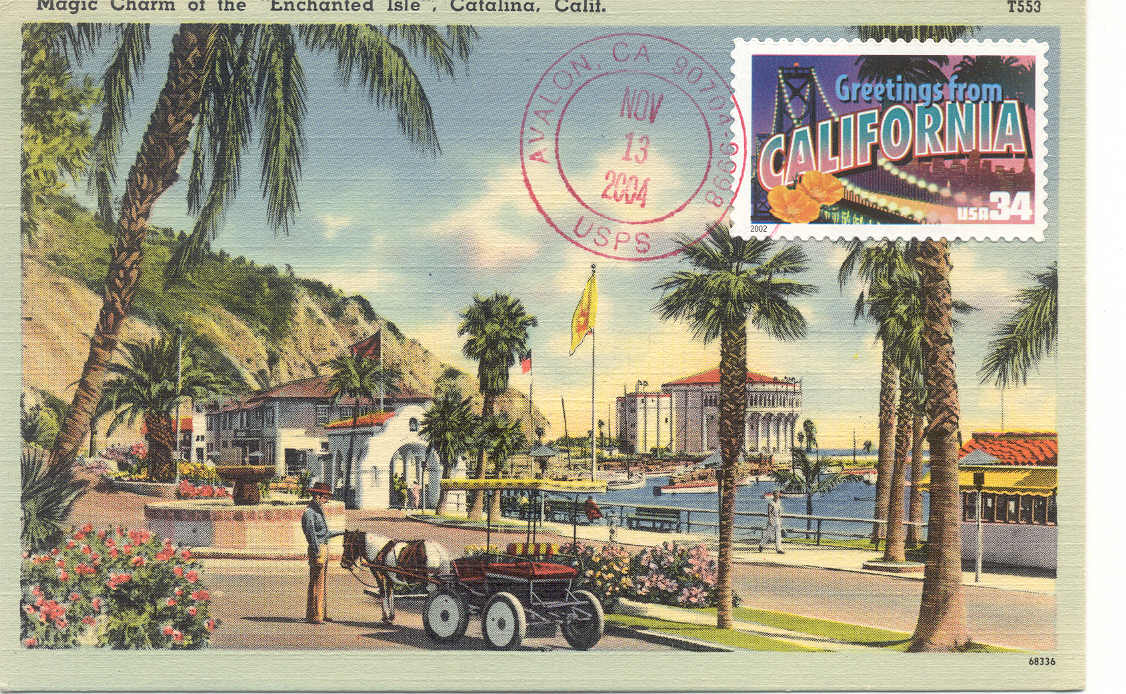
By and large, I've strayed away from collecting postcards, but recently, I've decided to try and pick up a few, in a few select areas. Old California, especially southern California, Pittsburgh, and old gas stations, motels, and stores. Since I have a small group of Catalina Island photos that I'll be posting next, these four images of Catalina Island, 26 miles across the sea from Long Beach, seemed like a good start. These are linen postcards, made from a high rag paper with a textured surface of parallel intersecting lines. Introduced in the early 1930's, they were the most popular type of postcard sold in the United States until the mid forties. Photo chrome postcards, which would come to dominate the market, were introduced in 1939. Even though the bright inks that were used in production, and the paper surface itself gave linen cards a painterly feel, the original images were primarily black & white photographs that had been hand colored. 99% of Santa Catalina Island was purchased, in 1919, by Chicago millionaire, William Wrigley, Jr. During his ownership, and the ownership of his sons, the Wrigley family poured millions into Catalina, building homes, resorts, hotels, the Casino, bird park, roads, airports, and fresh water reservoirs. The card of the two boats were part of the fleet that Wrigley owned to transport tourists to the island. The caption, "Happy vacationists board fast speed boats that skim the placid waters of Santa Catalina. As they whiz by, with their cheers of happiness and laughter. with greetings to the new arrivals is a thrill and delight to the passengers aboard the approaching steamer." It was mailed on Aug. 6, 1946 to "R.E. Brown, 816 Jackson St., Sioux City, Iowa" The message, "Hi Pop. I rode on both boats in Picture. We got here on the big one & took a 10 min. ride on the speed boat. Lot of love xxoo Charles. Having fun here." There is no message on either the Wrigley residence card or the bird park image. The caption of the Wrigley home card, "This palatial home was built by the late W. Wrigley Jr. and occupies a site on Mt. Ada, with a commanding view of Avalon Bay and coast-line of the island." No caption on the bird park card. Construction began on the Wrigley residence in 1920 and was completed in 1921. Mt. Ada was named for his wife. After Ada's death in 1958, it became a tourist attraction. In the 1970's it was given to USC, and used as a conference center. Since 1985 it's been an hotel. The bird park was built on 8 acres in Avalon Canyon by William Wrigley Jr. and opened in 1929. It had 500 cages and housed over 8,000 species of birds and was one of the largest aviaries in the world. It closed in 1966. The night scene is captioned, "Avalon Bay, a thrilling scene of bustling activity by day-"Fairyland by night." Like a jewel in an exquisite setting, the view of Avalon, at night from the hills above, is a never to be forgotten sight." Mailed Sept. 19, 1953, to "Mr. & Mrs G. We. Johnson, Laurene, Iowa." The message, "Dear Folks, We are up near the high point of this Island now and having a wonderful time. Reggie and Enid are with us. Now we are just about back to the bay and the boat will leave about 3:30. Minnie and Lester were over for dinner last night, Fri. We came up thru San Bernardino." Written in a different hand, "This has been the most enjoyable weekend we've had in ??? Love L.B. and Jean" Catalina was used for training in World War 2 and was closed to tourism. Coupled with the explosion in car ownership and cheap airfares to places like Hawaii and Baja, Catalina has never recovered as one of the major vacation spots in southern California. Pre-war, big bands played in the Casino, the circular building seen to the left of the ships and on the right of the night scene, swimming beaches were crowded, restaurants and hotels were full. Catalina is still a popular destination, but no where near what it was.
Labels:
boats,
california,
catalina,
hand colored photos,
postcards
Friday, May 28, 2010
Santa Catalina Island Across the Sea


And yet another souvenir photo, this time from Santa Catalina Island. Catalina is 26 miles across the sea, or so the line in the song goes, from Long Beach, California. Today, most of the island is owned by the nature Conservancy. There is a small town on the island, Avalon, that was once pretty much owned by Philip Wrigley of chewing gum fame. Written on the inside matt, "August 5, 1947. El Encanto, Catalina, Is." El Encanto is a small market place with souvenir shops and a couple of restaurants.
Labels:
california,
catalina,
night clubs,
Souvenir photo folders
Subscribe to:
Posts (Atom)