Showing posts with label Kodak. Show all posts
Sunday, April 29, 2018
You Press The Button, We Do The Rest
No, George Eastman did not invent photography, nor did he did invent film. What George Eastman did was see that the average person on the street would, given the chance, take pictures of their own. Before Eastman and Kodak came along, photographers needed a basic knowledge of chemistry, a light tight laboratory of their own, and a willingness to carry around a large camera that took photos on glass plate negatives and had to be used with a tripod. Eastman understood that if photography was made easy, photography would spread to the masses. His first attempt at mass market cameras, the detective, was a huge failure. It was his second try, the Kodak, that made his company a giant of American manufacturing.
George Eastman's idea was to build a camera that literally needed no real skill to operate. It was sold pre-loaded with a strip of film that could take 100 separate images; point and shoot, send the camera with the film still loaded back to Kodak, and Kodak would develop the film, make a single print of each image, reload the camera and mail the whole thing back to the camera's owner. Of course, at $25 in 1887, for the camera and film, true amateur photography was still limited to the well established members of the middle class and above, but in time that would all change. In 1900, Eastman introduced the first Brownie camera with a list price of $1.00 with no film included.
When I was a child,way back in the early 1960's, a cheap 127 camera made by Ansco could be had for $10, and a twelve exposure roll of film could be developed and printed for $5. The focus might have left something to be desired, and the plastic lenses didn't cut a super sharp negative, but then again, even poor people could take snapshots of their kids.
In all the years I've been collecting old photographs, this is the first time I've found a photograph from the original Kodak mass market camera. I don't know why George Eastman chose a format that gave round prints, but that's how they can be identified. In 1887, the Kodak prints were 2 1/2 inches in diameter, in 1888, the size went up to 3 1/2 inches, which is what this particular print is. Written on the back, "Me and my den as seen through a Kodak."
Labels:
books,
desk,
George Eastman,
Kodak,
round print,
snapshot,
snapshots
Monday, October 9, 2017
Getting Drunk As a Group Activity
They look too old to be frat boys, so maybe the company softball team. I noticed that some of these guys brought some really big containers. Kind of makes the red solo cup look inadequate. Take a look at the third photo and see that there is a Kodak Box Brownie camera in front of the keg. There is also one guy with a Dr. Pepper tee shirt. Fun story. I was born in southwestern Pennsylvania in 1955. It was hard to find Dr Pepper where I grew up. It was considered a southern hillbilly drink. If you drove forty miles south and crossed into West Virginia it was everywhere.
Labels:
alcohol,
beer,
box camera,
camera,
cameras,
Dr Pepper,
drinking,
group shots,
keg,
Kodak
Wednesday, October 29, 2014
The Salesman
What is this man selling? Let's see...Argus slide viewers, a home haircut kit, a Kodak Starflash Camera, typewriters, a clock, a tripod, Shaffer pens, a movie projector, and what looks like some sort of audio equipment in the radio, record player, open reel tape recorder type of stuff. All things I can remember, and some of which, when I was young, I found amazing. So, pawn shop or general store?
Labels:
Argus,
cameras,
hat,
Kodak,
open reel tape recorder,
pawn shop,
pens,
radio,
record player,
salesman,
slide viewer,
store,
stores,
tripod,
typewriter
Wednesday, July 30, 2014
Women, Early's Kodak
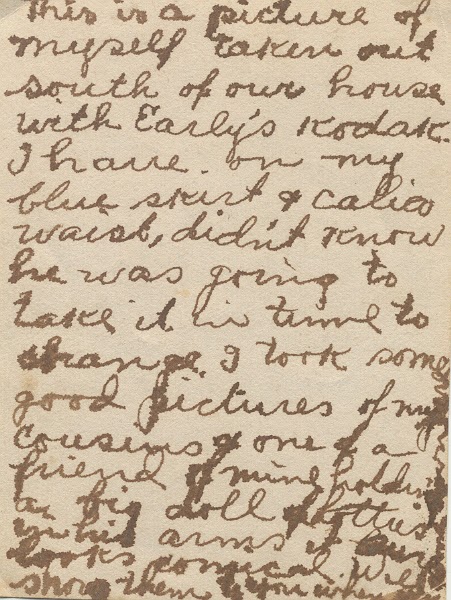
The writing on the back of the photo was a bit smeared, and I had some problem making out the bottom couple of lines, so have at it. I like the idea of Early and our model roaming around the country side, Kodak in hand, taking pictures. I'm intrigued by the idea of her friend, posing with a big doll. And, how do arms look comical? Old photos usually have more questions than answers.
Tuesday, April 15, 2014
Cine Kodak Eight Model 20
I love photographs of people holding cameras, especially when it's a camera in my collection. The Cine Kodak Eight Model 20 (Mine still works.) is one of the most important mass market movie cameras ever made. Introduced in 1932, as the great depression took it's toll on Kodak's bottom line, the Model 20 was the first double 8 camera ever made. (Also know as regular 8 or straight 8.) Some unknown Kodak engineer came up with a very simple idea. Take a roll of 16mm movie film, the standard for home movies, double the number of perforations, expose only one half the width of film per pass through the camera, flip the reel over, run it through the camera a second time, exposing the other half of the film. Four frames where there had been one. A 25 foot reel of double 8 would have the same run time as a 100 foot reel of 16mm. After processing, the film had to be slit in half, and the two lengths spliced together, but the greater processing costs were small compared to the savings in film stock. At a time when the vast majority of Kodak's customers were short of money, the Cine Model 20 kept Kodak in the home movie business.
So, what difference does it make if a double 8 camera still works when the film is no longer made? Actually, in a way, it still is. While no surviving film company still manufactures the film, some do make 16mm. There are companies that still have working 8mm perforating machines. They buy 16mm, run it through the perforating machines, and new double 8 is made. In the United States, Dwayne's Photography in Parsons, Kansas. If interested, go to their website, and place an order. They'll process it too. All part of the service. It's not cheap, but it does keep those of us who love film happy. And while I haven't bothered to do the research, I'd be surprised if there aren't small operations like Dwayne's still operating in Europe, Asia or South America.
Just looking at this picture, I'm betting that it was taken sometime in the early to mid fifties. The cars are older than that, but our budding John Ford is pretty young, and he and his friends were probably driving older cars. Too, take a look at the bottom of the print. Short shorts, plus the hair cut, and the expanding metal watchband...well, I could be wrong, but taken together, I'm not getting a feel for an earlier time period.
And finally...The serial number on my camera is AK 6181. That has to be pretty early in the manufacturing run. Perhaps, 1932.
Labels:
automobiles,
cameras,
cars,
Kodak,
movie cameras,
movies
Saturday, January 12, 2013
The Camera Couple and The Third Wheel
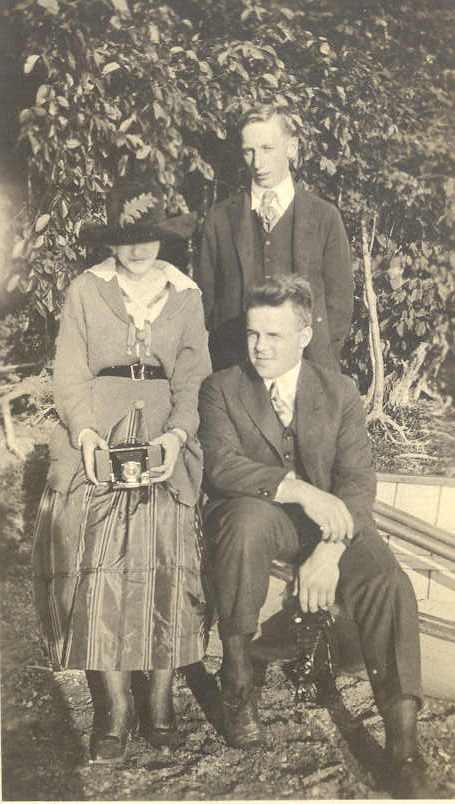
I do love my photographs of photographers. I've just gone through one of my favorite reference books, 500 Cameras, 170 Years of Photographic Innovation by Todd Gustavson and the closest match I can find to the lady's camera is a No. 4 Screen Focus Kodak, Model A, first made in 1904. Of course, once a company made a nice camera, it wasn't long until another company came up with a copy. And the man's camera, a bit difficult to see down there between his legs, looks like it might be a Kodak Autographic first made in 1916. I have one in my collection and a number of others that look pretty much the same. Oh well. Now, is the third person their model, or just the guy that they couldn't ditch before heading out on a camera outing? Maybe his camera is on a tripod with a self timer. Either that, or there's a forth person and with luck the third man's date.
Subscribe to:
Posts (Atom)