Showing posts with label Bavaria. Show all posts

Thursday, September 9, 2021

Otto From Wurzberg


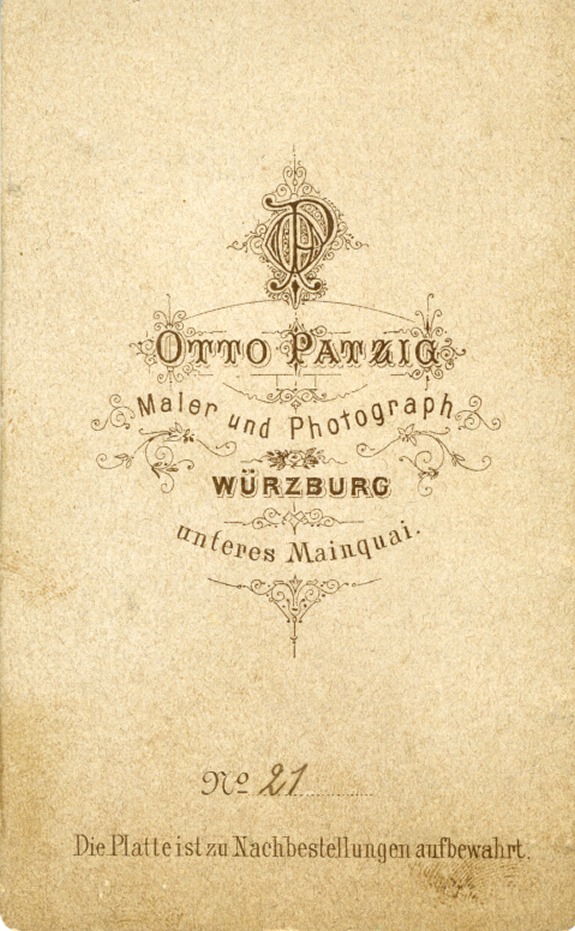
Otto Patzig, photographer from Wurzburg, Germany.  Well, I couldn't find much about Otto.  One very brief mention that he was a photographer and painter from the city.  Apparently a minor one, since I couldn't find any images of his paintings and the only photos I could find were other CDVs for sale on eBay, which is where I got this one.  I liked the hat.  Maybe a student, maybe a minor government functionary, but not military. 

Wurzburg, on the other hand, lots of info on the city.  Some of the low lights.  Between 1626 and 1631 there were witch trials with somewhere between 600 and 900 executions.  All burned alive.  On August 2, 1819, the Hep-Hep riots started in the city and eventually spread, first through Bavarian and then the rest of Germany.  The Hep-Hep riots were anti Jewish, so a precursor of things to come in Germany.  During World War 2 a sub unit of the Flossenburg concentration camp was located in the city.  And finally, on the night of March 16, 1945, a bombing run carried out by British Lancaster bombers destroyed 90% of Wurzburg.  Not an end, by the way.  A rebuild and restoration.

Monday, August 25, 2014

The Pforzheim Album 11


There's always a lot of speculation when I post these old photos.  I've speculated that the owner of this album was from Pforzheim, Germany because the first two photos in the album, in a place of prominence,  were from Pforzheim photographers, and because the only commercially produced postcard is of a Pforzheim landmark.

 But, there are a lot of towns associated with the images in the collection, two new ones in this post.  There's a photographers stamp on the back of the top photo.  "Photographie, G. Lampe, Baden-Baden, Ludwig Wilhelm, PL. 5"  Yet another town in Baden-Wurttemberg.  For those who can't make out the embossed credit on the bottom card, "Eder & Sohn, Kempten i. Allg"  Kempten is in the Allgau region of southwest Bavaria, near the Baden-Wurttemburg border.  It's also the oldest urban settlement in Germany, known to have been inhabited as early as 50 B.C.

Of course, there's a lot more to wonder about than where the owner of this album actually lived.  I don't know about anyone else, but every time I see photos from Germany taken in the years before World War 2, I wonder what the people in those photos believed.  Going on the assumption that all the photos in the album were taken in the late twenties, the little boy in the baby carriage, almost certainly,  became a member of the Hitler Youth.  But was he a loyal follower of the Fuhrer, or did he go along to get along?  The small boy in the lower photo would have been the right age to fight in the war.  Was he army, navy, a flier, the S.S.?   Did he survive?  And if he survived, did he go back to an ordinary life, or was he tried as a war criminal?

I'm not going to try and translate the handwriting on the back of the top postcard, but the name Huck makes another appearance.  This time Josef.  Baby or father?  Perhaps a native German speaker can let us know.

Tuesday, April 22, 2014

How Not To Take A Picture


A young man is receiving some sort of prize.  That prize obscures the bottom half of his face.  The presenter has his face turned away from the camera.  The announcer's face is blocked by the microphone.  At least we can see the trombone players.  Stamped on the back, "FOTO-DOMES EICHSTATT."  Eichstatt is a town in Bavaria, Germany.

Thursday, February 6, 2014

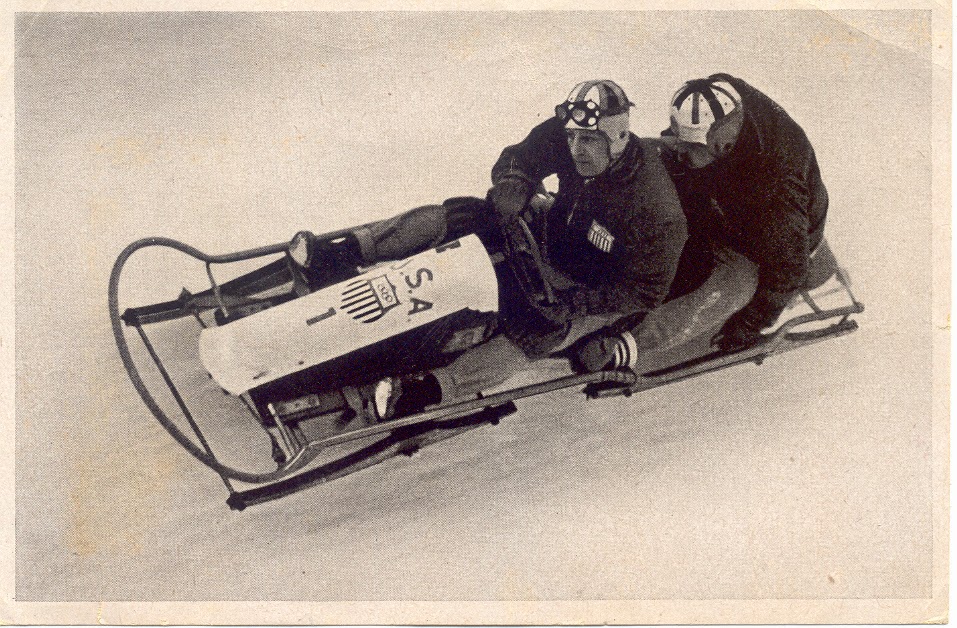
Zweierbob


No, I'm not going to translate the text from this German tobacco card.  My one term of college German, forty years ago, and Google translate isn't enough to  figure out what all this says.  Any German speakers out there, have at it, and if you're willing to post a translation in the comments section, I for one will be grateful.

We've all heard of the Nazi Olympics of 1936.  Berlin, Jessie Owens, and all that.  But, there were two Nazi games.  1936 was the third and last time  the same country hosted both the summer and winter games. Garmisch-Partenkirchen, a resort town in Bavaria, hosted the skiers, skaters and bob-sledders.

G-P (No, I'm not going to spell it out every time.) is also the place where Avery Brundage, the only American IOC President, died.  That's an interesting coincidence, because Brundage was partly responsible for an American presence at Berlin and G-P.   The IOC had awarded the games to Germany in 1931, the year before the Nazis came to power.  After Hitler became Chancellor, and well before the games were set to begin, Jews had been expelled from all German sports clubs,and the anti-Jewish Nuremberg Laws had been passed.  Kristallnacht was two years in the future.

As a response to the growing anti-Semitism in Germany, a movement to withdraw from the German games began within the American Olympic Committee.  Avery Brundage, at the time a member of the committee and head of The Amateur Athletic Union, became the major opponent of a boycott.  At one point he referred to what was going on in Germany as a minor religious dispute.  In the end, Brundage won the day.

Brundage was also instrumental in Jessie Owens fourth gold medal in the 4x100 relay at Berlin.  Owens wasn't scheduled to be in the race, but Brundage ordered the removal of two Jewish runners from the event.  To Owens' credit, he tried to refuse his placement in the race, but wasn't given a choice.  Ralph Metcalfe, the other replacement, also tried to decline a spot in the relay.  When Jessie Owens left a post Olympic tour of Europe to return home, Avery Brundage stripped him of his amateur status.  Nice guy.

So, how did Brundage end his days in G-P?  At the age of 85, he married a 36 year old German princess, and became a German resident.

I'd say we learned from all this, but current IOC President Thomas Bach is  trying to put on a happy face about Russian human rights violations, including anti-gay laws.  Let the games begin!